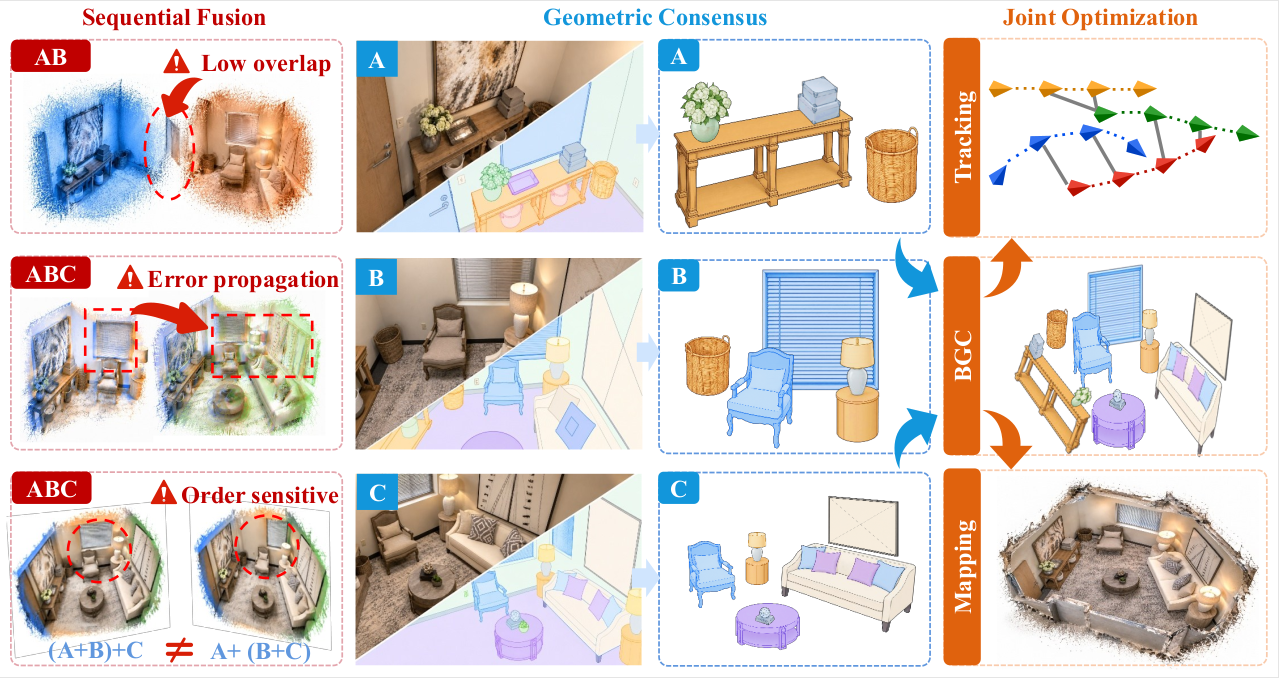
Collaborative 3D Gaussian SLAM must reconcile independently reconstructed submaps whose overlap is often partial and whose Gaussian decompositions may differ across agents. Pairwise registration and sequential fusion can make the global estimate sensitive to uncertain intermediate geometry and fusion order. We present BarySLAM, which organizes cross-agent information around Barycentric Consensus Geometry (BCG), a partially supported latent geometric representation shared by agents observing the same scene structure.
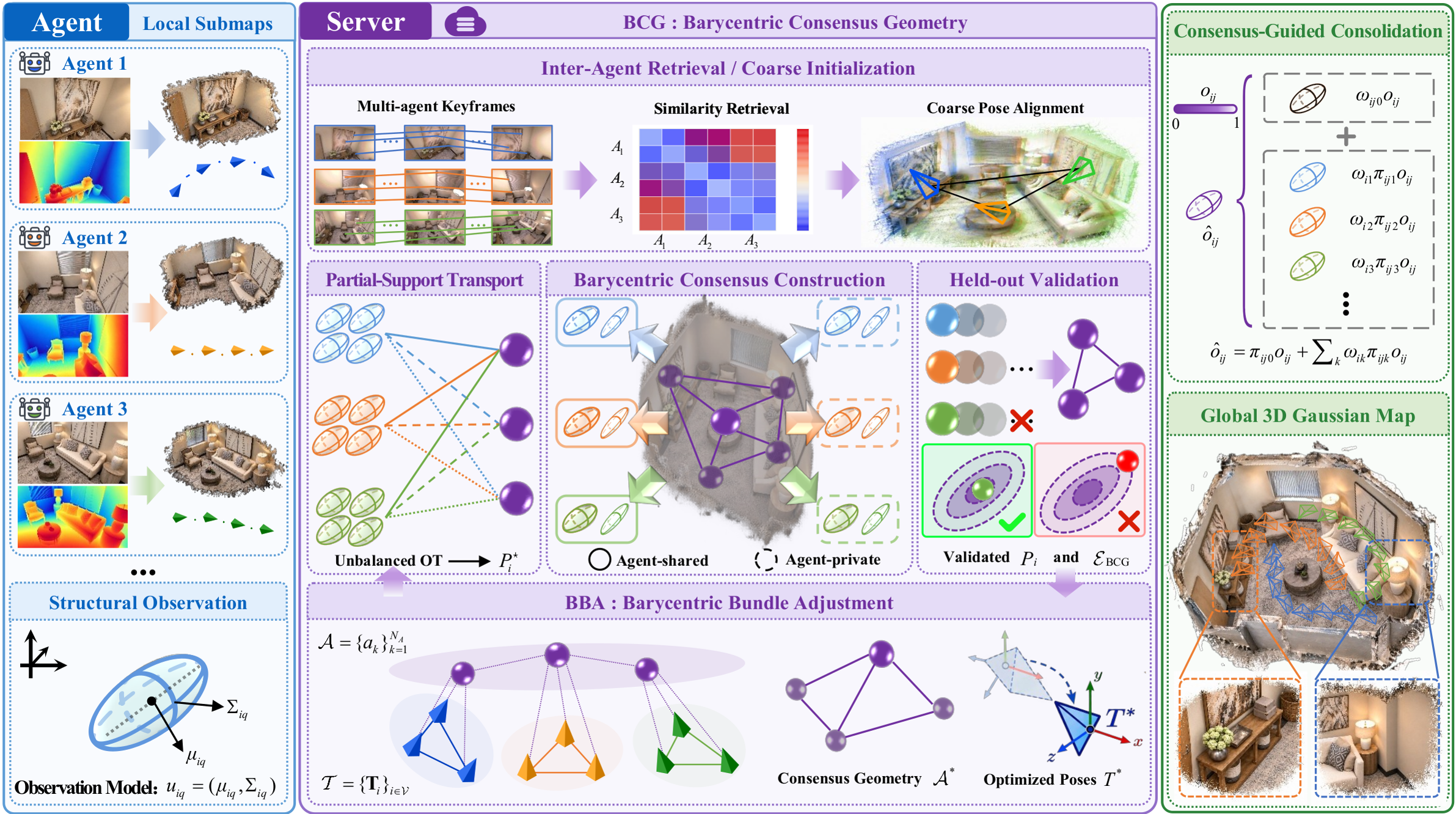
BarySLAM derives structural observations from local Gaussian fields, establishes partial cross-agent support through unbalanced optimal transport, and jointly refines submap poses and consensus geometry with held-out validation to suppress inconsistent cross-agent evidence. The validated consensus is then transferred to the original Gaussian primitives for global map construction, maintaining a common geometric basis from collaborative estimation to reconstruction.
Experiments on synthetic and real multi-agent benchmarks show state-of-the-art overall performance in trajectory estimation and Gaussian reconstruction, with improved robustness under limited overlap and corrupted cross-agent registration and reduced sensitivity to fusion order.
BarySLAM realizes the shared-state formulation through a unified estimation and reconstruction process with three stages: BCG constructs the consensus graph, BBA jointly refines poses and latent geometry, and CGC transfers validated support back to the renderable Gaussian primitives.
We evaluate on ReplicaMultiagent (four collaborative RGB-D scenes with ground-truth poses and metric depth) and AriaMultiagent (real-world Room0 / Room1 with larger viewpoint variation). Trajectory accuracy is measured by ATE RMSE (cm); reconstruction by PSNR, SSIM, LPIPS, and depth L1 error (cm).
| Method | ReplicaMultiagent — ATE RMSE (cm) ↓ | AriaMultiagent — ATE RMSE (cm) ↓ | ||||||
|---|---|---|---|---|---|---|---|---|
| Off-0 | Apt-0 | Apt-1 | Apt-2 | Avg. | R0 | R1 | Avg. | |
| Swarm-SLAM | 1.42 | 1.80 | 5.56 | 5.61 | 3.60 | 6.45 | 4.78 | 5.62 |
| MNE-SLAM | 0.31 | 0.48 | 1.02 | 0.59 | 0.60 | 1.81 | 0.95 | 1.38 |
| MAGiC-SLAM | 0.27 | 0.16 | 0.26 | 0.32 | 0.25 | 1.15 | 0.65 | 0.90 |
| MultiSlam | 0.58 | 0.47 | 0.65 | 0.36 | 0.52 | 1.05 | 0.85 | 0.95 |
| MAGS-SLAM | 0.29 | 0.46 | 0.46 | 0.31 | 0.38 | 0.86 | 0.54 | 0.70 |
| BarySLAM (Ours) | 0.21 | 0.16 | 0.25 | 0.17 | 0.20 | 0.61 | 0.55 | 0.58 |
Collaborative trajectory estimation on ReplicaMultiagent and AriaMultiagent. Each entry is averaged over all agents in the corresponding scene. Best results in bold.
| Method | Office-0 | Apartment-0 | Apartment-1 | Apartment-2 | Avg. | |||||
|---|---|---|---|---|---|---|---|---|---|---|
| PSNR↑ | SSIM↑ | PSNR↑ | SSIM↑ | PSNR↑ | SSIM↑ | PSNR↑ | SSIM↑ | PSNR↑ | SSIM↑ | |
| CP-SLAM | 28.56 | 0.870 | 26.12 | 0.790 | 12.16 | 0.310 | 23.98 | 0.810 | 22.71 | 0.690 |
| MAGiC-SLAM | 39.32 | 0.990 | 36.96 | 0.980 | 30.01 | 0.950 | 30.73 | 0.960 | 34.26 | 0.970 |
| GRAND-SLAM | 43.12 | 0.990 | 44.15 | 0.990 | 38.65 | 0.990 | 39.46 | 0.990 | 41.35 | 0.990 |
| CoMA-SLAM | 42.77 | 1.000 | 42.28 | 0.990 | 33.86 | 0.980 | 34.59 | 0.980 | 38.38 | 0.990 |
| OminiMAG-SLAM | 41.21 | 0.990 | 39.25 | 0.990 | 33.10 | 0.960 | 34.21 | 0.960 | 36.94 | 0.980 |
| BarySLAM (Ours) | 43.48 | 0.995 | 44.62 | 0.996 | 39.12 | 0.988 | 40.03 | 0.991 | 41.81 | 0.993 |
Training-view reconstruction on ReplicaMultiagent (PSNR in dB). BarySLAM achieves the strongest average performance across PSNR, SSIM, LPIPS, and depth L1.
| Method | Training — Room-0 | Training — Room-1 | Training — Avg. | Novel — Room-0 | Novel — Room-1 | Novel — Avg. | ||||||
|---|---|---|---|---|---|---|---|---|---|---|---|---|
| PSNR↑ | SSIM↑ | PSNR↑ | SSIM↑ | PSNR↑ | SSIM↑ | PSNR↑ | SSIM↑ | PSNR↑ | SSIM↑ | PSNR↑ | SSIM↑ | |
| MAGiC-SLAM | 23.19 | 0.870 | 26.16 | 0.930 | 24.68 | 0.900 | 21.94 | 0.850 | 21.59 | 0.850 | 21.77 | 0.850 |
| OminiMAG-SLAM | 22.92 | 0.910 | 27.23 | 0.930 | 25.08 | 0.920 | 21.77 | 0.840 | 21.93 | 0.860 | 21.85 | 0.850 |
| BarySLAM (Ours) | 24.70 | 0.930 | 27.30 | 0.950 | 26.00 | 0.940 | 22.70 | 0.870 | 22.60 | 0.870 | 22.65 | 0.870 |
Training- and novel-view reconstruction on AriaMultiagent. The advantage is retained under held-out viewpoints, where residual cross-agent inconsistency is more likely to become visible.
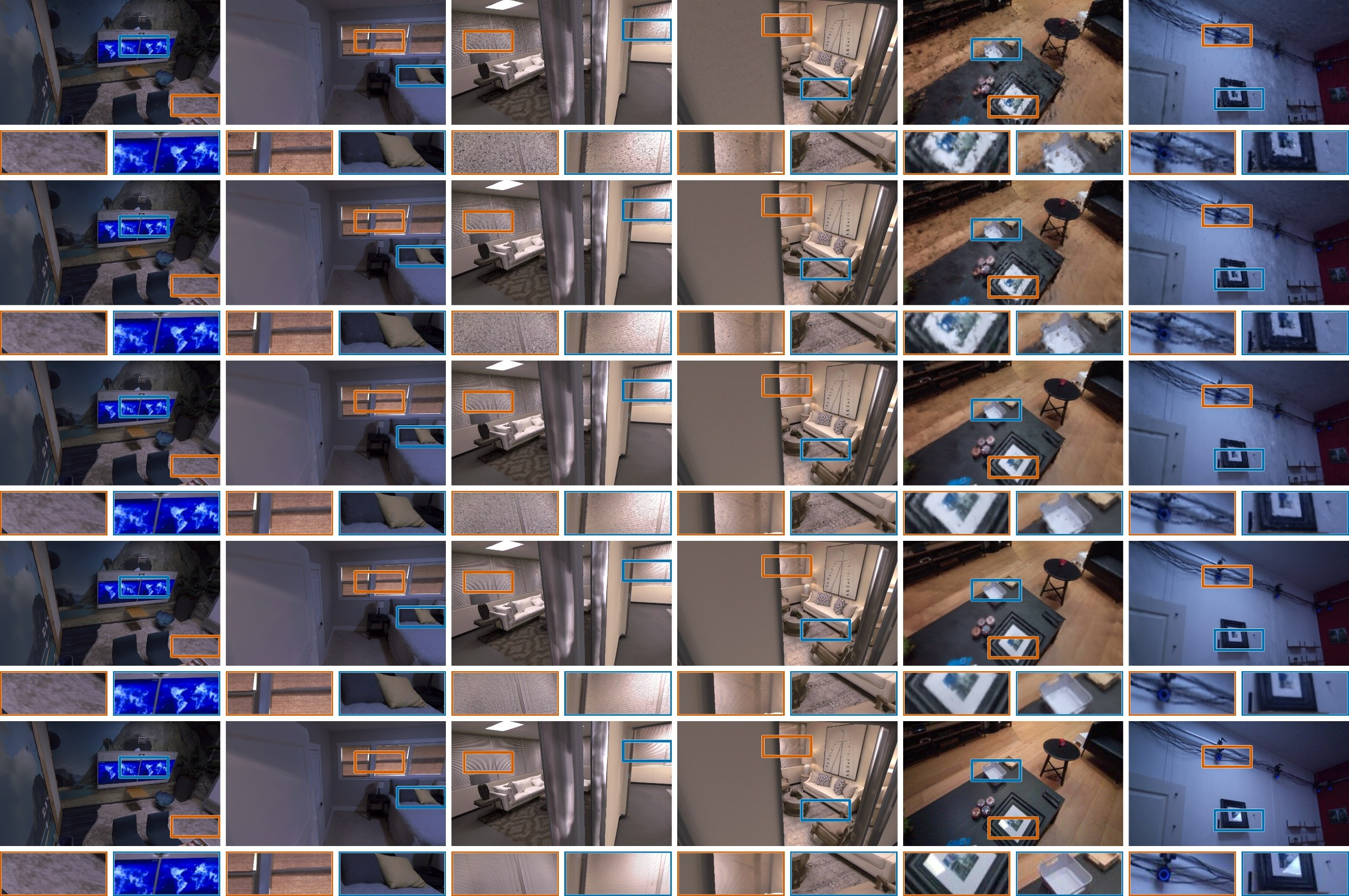
BarySLAM achieves the lowest average ATE on both benchmarks while remaining competitive across all evaluated scenes. The consistent improvement in image-space and depth-space measurements indicates that the refined cross-agent geometry is preserved in the final renderable Gaussian map.
@inproceedings{baryslam2027,
  title     = {BarySLAM: Barycentric Consensus Geometry for Collaborative 3D Gaussian SLAM},
  author    = {Anonymous Authors},
  booktitle = {International Conference on Learning Representations (ICLR)},
  year      = {2027},
  note      = {Under review},
}